

“I need a little siesta before we go out tonight.”
Mixing a familiar Spanish word into an English sentence may feel effortless to a human reader. In fact, many bilingual people do this. This practice, known as code-mixing, combines two or more languages within the same sentence, or even a single word. But what makes sense to people exposed to different languages all the time can confuse artificial intelligence systems, creating problems when those systems translate, moderate, or summarize social media posts and other human communication.
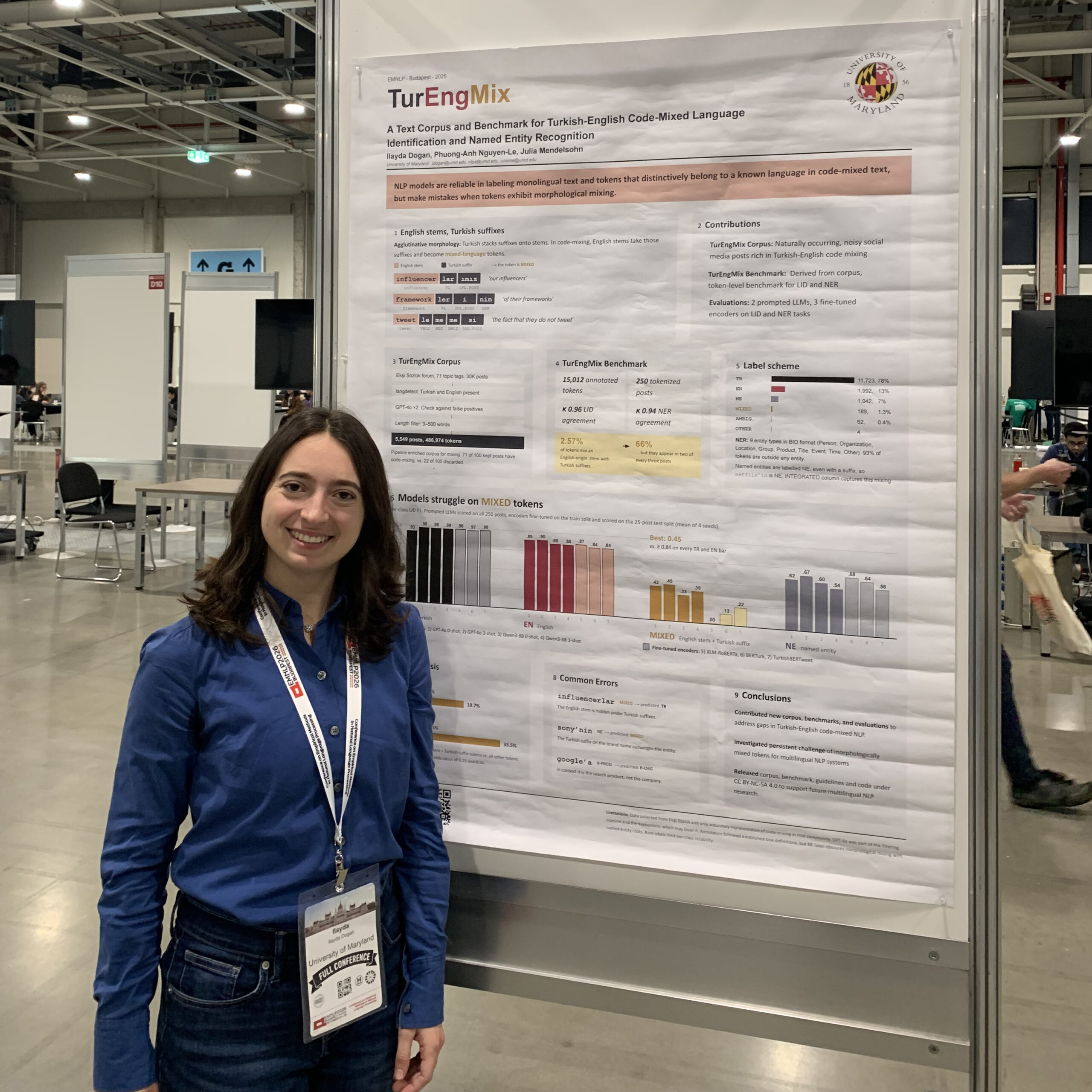
Senior Ilayda Dogan is investigating that gap. A computer science major who completed the Honors Global Challenges and Solutions (HGLO) program, she developed TurEngMix, a research dataset and benchmark that tests how well language models understand Turkish-English code-mixing.
Dogan began exploring code-mixing for low-resource languages as a junior with guidance from Kem Nguyen-Le, a doctoral student in the College of Information, and Dr. Julia Mendelsohn, a faculty mentor at the University of Maryland Institute for Advanced Computer Studies. When she found little research about Turkish-English communication, she set out to build her own dataset through an independent research project. Dogan, who speaks Turkish and English natively, developed scripts to collect and process posts from a Turkish social media forum, focusing on topics such as technology and entertainment where English terms like “link,” “tweet,” and “influencer” often appear. From a collection of more than 5,000 posts, she developed a benchmark to test whether models could identify each word’s language and recognize names of people, places, and other entities.
Turkish presents a particularly interesting challenge. Speakers can attach multiple Turkish suffixes to an English word, combining the two languages within a single word. For example, “influencerlarımız” means “our influencers.”
“It becomes a word that’s both English and Turkish at the same time,” Dogan said. “And then large language models get very confused.”
Her work measures those shortcomings, and her public dataset gives researchers a resource for evaluating and improving systems that need to understand how multilingual communities actually communicate.
This work is not just about technical accuracy. Dogan cautions that AI systems that perform well in English may still misunderstand other languages, especially when people mix languages within a sentence or word. Those gaps matter when systems are used to translate posts, moderate content, or generate summaries. “If we’re just assuming that they can do that really well across languages because we see they can do it well in English,” she said, “that can cause a lot of issues down the line.”
Her first-author paper was recently accepted to the Workshop on Natural User-Generated Text at the Conference on Empirical Methods in Natural Language Processing, which took place last week in Budapest, Hungary. It was also selected for an oral presentation, so she could share her methods and findings with an international research community.
“Presenting our research at EMNLP 2026 in Budapest was an inspiring experience as an undergraduate researcher,” she said. “I especially valued the thoughtful conversations at our talk and poster, and the opportunity to learn from such a welcoming research community.”
HGLO supported Dogan’s conference participation with funding, and she also credits the program’s combination of social science, data science, and global issues with shaping her interest in research that connects computing with public good. As she prepares to apply to doctoral programs, she hopes to continue investigating where language models fall short and how those gaps affect the people who use them.
—
The Honors Global Challenges & Solutions (HGLO) program combines social science and data science to help students understand and address global challenges through interdisciplinary coursework, original research, and public service within an inclusive, interculturally conscious community. Learn more at hglo.umd.edu.


