
HONR 215: One Maryland, Our Maryland: Building Connections across a Pluralistic State
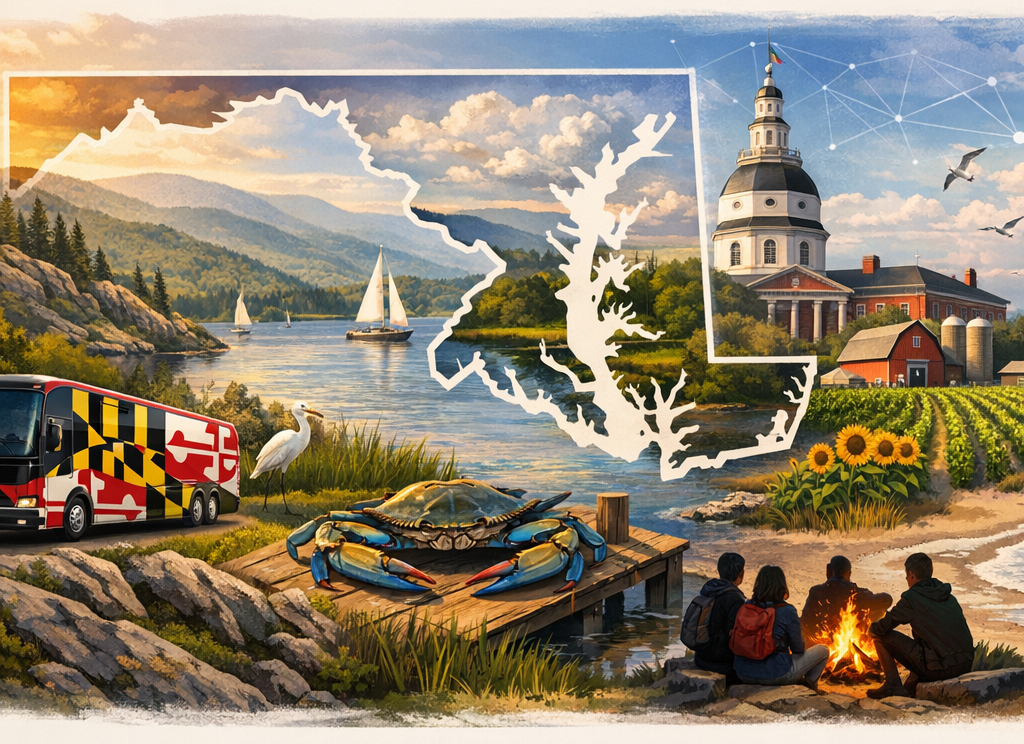
HONR 215: One Maryland, Our Maryland Building Connections across a Pluralistic State
Spring Break 2027. Would you like to go to the beach, hike in the mountains, visit museums and cultural centers, stay with your friends in a hotel, and earn 3 credits for your adventures? That’s the idea behind HONR 215. It’s a gen ed class (Understanding Plural Societies) that offers a deep dive into the people, places, and stories that make Maryland home. And it’s all in the spirit of preparing you to be among the state’s next generation of leaders.
Course snapshot
This Honors seminar plus spring-break study-away experience turns Maryland into your classroom. This class is about preparing you to be the next generation of leaders for this state, in whatever field you choose, whether a business leader, community leader, elected official, or other positions of leadership.
Over the semester, you’ll explore the state through six core themes: agriculture, ecosystems, politics, history, culture, and industry. You’ll look closely at how different communities—Indigenous peoples, Black Marylanders, colonists and immigrants from Europe, and more recent migrants from Asia, Africa, and Latin America—have helped shape the Maryland you live in today, and how geography and economics layer onto those human stories.
The course invites you to ask big questions about power, identity, and belonging in a pluralistic society. You’ll analyze how policies, institutions, and histories of coloniality and slavery create hierarchies and inequalities, and you’ll study how Marylanders work to challenge those structures and build more equitable futures.
Why this course stands out
Instead of studying Maryland from a distance, you’ll dig into real case studies that sit at the intersection of environmental change, economic transformation, and community life—for example, the disappearing oyster industry in the Chesapeake Bay. You’ll explore how overharvesting has affected not only aquatic biodiversity, but also the human economies and communities that co-exist with the bay. You’ll also get to see how local residents and organizations are innovating to ensure the long-term health of the bay and its people.
Throughout the course, you’ll engage with scholars, advocates, and practitioners—from environmental scientists and policy experts to community historians and cultural organizers. The goal is to equip you not just with knowledge about Maryland, but with the analytical tools and experiences you need to think like a leader in and for this state.
Spring Break 2027: Maryland, on the ground
Everything builds toward an eight-day, faculty-led study-away trip across Maryland during Spring Break 2027, which counts for course credit and the Understanding Plural Societies gen end requirement. Instead of a traditional vacation, you and your classmates will spend the week traveling through multiple regions of the state, connecting classroom learning to lived realities.
You can expect days like:
- Baltimore – Exploring history and culture at museums and archives; visiting urban farms and food industry sites; meeting with organizations working at the intersection of environment, health, and community.
- Eastern Shore – Engaging with scientists at the University of Maryland Center for Environmental Science; visiting Blackwater National Wildlife Refuge; tracing the legacies of resistance and freedom at the Harriet Tubman Underground Railroad National Historical Park; talking with local leaders in Ocean City about tourism, economy, and coastal change.
- Annapolis – Stepping inside state politics through visits with senators, delegates, and UMD interns at the Maryland General Assembly to see how ideas become legislation and how communities make themselves heard.
- Western & Central Maryland – Learning about forestry, agriculture, and industry in rural and suburban communities, and how these regions fit into broader questions of sustainability and equity.
- Baltimore (final day) – Meeting community-based organizations, seeing how creative reuse and environmental design work in practice, and reflecting on how everything you’ve learned connects back to your own role in Maryland’s future.
During the trip, you’ll keep a digital journal capturing your observations, conversations, and questions. That reflective practice turns every site visit into an opportunity to think more deeply about the kind of citizen, neighbor, and leader you want to be.
What you’ll do academically
Even with its immersive, travel-based format, this is still a rigorous Honors course. You’ll:
- Build advanced skills in analyzing texts, policies, and cultural expressions in their Maryland contexts.
- Use intersectional and comparative frameworks to understand the experiences of multiple social groups across time and space.
- Learn to identify and explain how structures and ideologies create or challenge inequality.
- Connect human diversity to ecological and economic transformations in concrete, specific ways.
Your major work includes:
- Digital journal (20%) – Participation activities, reading responses, and daily reflections, especially during the study-away trip.
- Issue briefs (60%) – Three concise, research-based briefs on current issues facing Maryland communities, shared with classmates and presented in class.
- Final group project (20%) – A collaborative proposal, either a policy justification or a funding justification, that makes a researched argument for a specific solution to a Maryland issue.
Who should enroll
Choose this course if you’re curious about how history, environment, and politics intersect in everyday life—and if you want to see more of Maryland than campus and the immediate College Park area. It’s a great fit if you:
- Enjoy connecting big ideas to real-world problems.
- Want to understand the communities and ecosystems that surround UMD.
- Are excited by the idea of spending Spring Break 2027 traveling with fellow Honors students, learning directly from people who are shaping Maryland right now.
If you imagine yourself someday working in policy, public service, environmental science, community organizing, business, or any field that engages with complex, diverse societies, this course offers a powerful, Maryland-focused foundation.