
Duncan Kuchar in race car

From Classroom to Racetrack: Honors Engineer Duncan Kuchar ’26 Leads Breakthrough in Active Aerodynamics

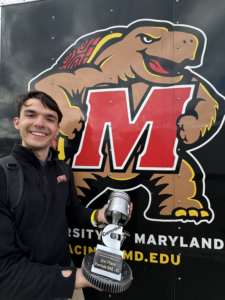
Duncan Kuchar with Formula SAE award
Kuchar holds the 2nd Place Formula SAE (FSAE) Internal Combustion (IC) Innovation Award at the 2025 FSAE Michigan competition.

When most people picture a racecar, they think about pure horsepower, but the science of racing is much more nuanced. For Aerospace Engineering Honors and Interdisciplinary Business Honors (IBH) senior Duncan Kuchar ’26, the real action is in controlling the air around the car.

Over the past few years, as aerodynamics lead for Terps Racing’s internal combustion Formula SAE team, Kuchar developed a fully autonomous active aerodynamics system for the team’s TR25 racecar. This work became his Aerospace Engineering Honors thesis and the first project of its kind in the international Formula SAE community. Instead of relying on a driver to manually flip a wing setting (like in Formula 1’s Drag Reduction System, also known as DRS), his system uses a six‑element wing package with actuated flaps on both the front and rear wings, and is completely autonomous. A special algorithm called a Finite State Machine reads key details like wheel speed, steering angle, throttle position, brake pressure, and inertial sensors to estimate what the car is doing and then adjusts the wings in real time. 

“We wanted the car to make those decisions faster than any human could, so the driver can focus on driving while the wings optimize everything in the background,” he explained. 
Kuchar explains the science behind the autonomous active aerodynamics system he and his team created.

The result is a car that can add downforce for grip in corners and reduce drag on the straights. The Terps Racing team earned the Second Place Innovation Award at the 2025 Formula SAE Michigan competition for their cutting-edge design, supported in part by an Honors College thesis research grant for Kuchar’s project.

This mix of autonomy, control, and aerodynamics has become even more timely as new Formula 1 rules introduce full active aerodynamics on both front and rear wings. Duncan’s project taps into that same engineering approach, and it has already garnered lots of attention: his first social posts on the Terps Racing Instagram account about the system have already drawn millions of views from motorsports fans, engineers, and aspiring researchers around the world. Other campus clubs and Formula SAE teams have reached out to learn how Terps Racing pulled it off. 

“Seeing messages from so many asking how we did this has been surreal—it shows what’s possible when we as students have the support to try something new,” he said.

The Terps Racing IC team during the 22km endurance race. The active aerodynamics can be seen opening and closing down the straight portion of the course.

Animations showing the airflow around different components of the car, which were created through simulations on the University of Maryland’s High Performance Computing (HPC) Cluster, Zaratan.

Kuchar has long been drawn to complex systems that blend hardware, software, and strategy. In high school, he led a FIRST Robotics team, an experience he sees as the perfect gateway to Formula SAE, and knowing that UMD had a Formula SAE presence was one of the main reasons he chose this university. He joined Terps Racing in his first semester and stepped into the aerodynamics lead role by his second semester on campus. For the past three years, he has helped design and drive the car, spending late‑night test sessions in campus parking lots to get competition‑ready.

For Kuchar, the project also embodies the interdisciplinary mindset he developed as a student in the Interdisciplinary Business Honors (IBH) program during his first two years at UMD. Terps Racing, he notes, runs like a small company, with student leaders responsible not only for design but also for timelines, budgets, sponsor relationships, and team culture. IBH has helped him think beyond pure engineering: knowing when to stop refining a design so drivers can get seat time, understanding how decisions in one subsystem ripple across the whole vehicle, and recognizing the importance of communication and stakeholder management. He has recruited other IBH students onto the team precisely because those skills make the engineering stronger.

As social media clips of the project continue to circulate and inspire, Duncan is finishing his combined B.S./M.S. in aerospace engineering, with interests now expanding into drones, acoustics, and autonomous systems. Between returning to his internship at MIT Lincoln Laboratory this summer and advising the next generation of Terps Racing students, he sees this honors thesis not as a final product, but as a launchpad for his own career and for future Maryland engineers who want to push what’s possible on and off the racetrack.

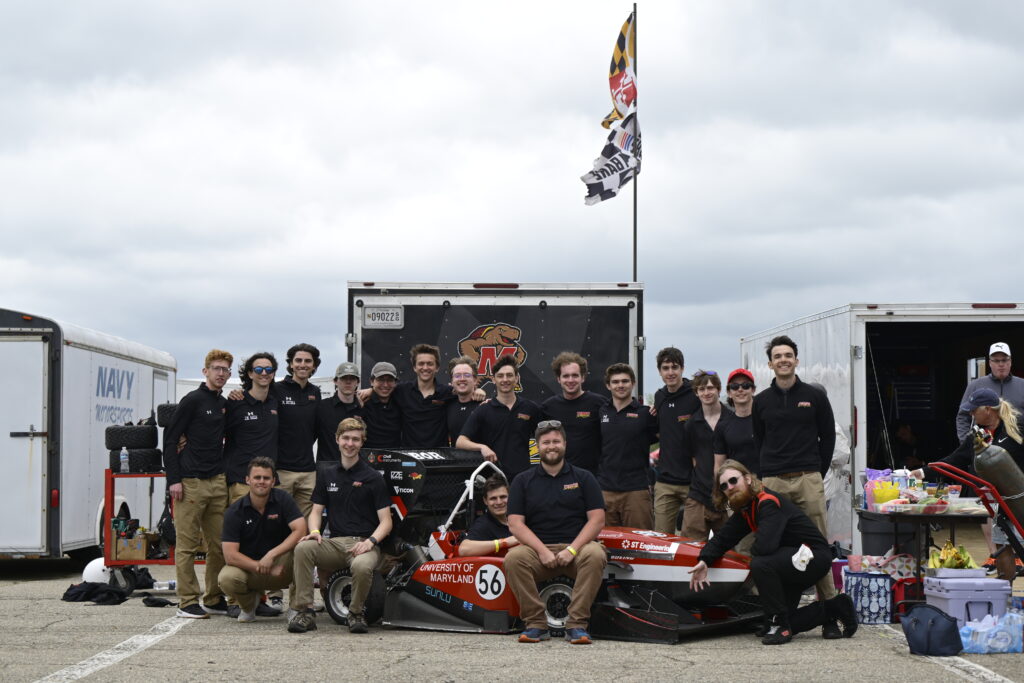
Terps Racing team at 2025 Formula SAE Michigan

The Terps Racing Formula IC team at the 2025 FSAE Michigan competition.

The Aerospace Engineering Departmental Honors program offers top-performing undergraduates an advanced curriculum that combines honors-level coursework with a faculty-mentored research project culminating in a written thesis and formal presentation, preparing students for technical leadership and advanced research.

The IBH program provides students with access to cutting-edge professional and technical business skills and provides opportunities for broader thinking about the role of business in the world through multiple disciplines.

Photos and videos courtesy of Duncan Kuchar.

Honors Communications

Related